Coaching the Next Generation of AI PMs: Inside the Treford AI PM Program
Some projects start with a plan. Others start with a conversation.
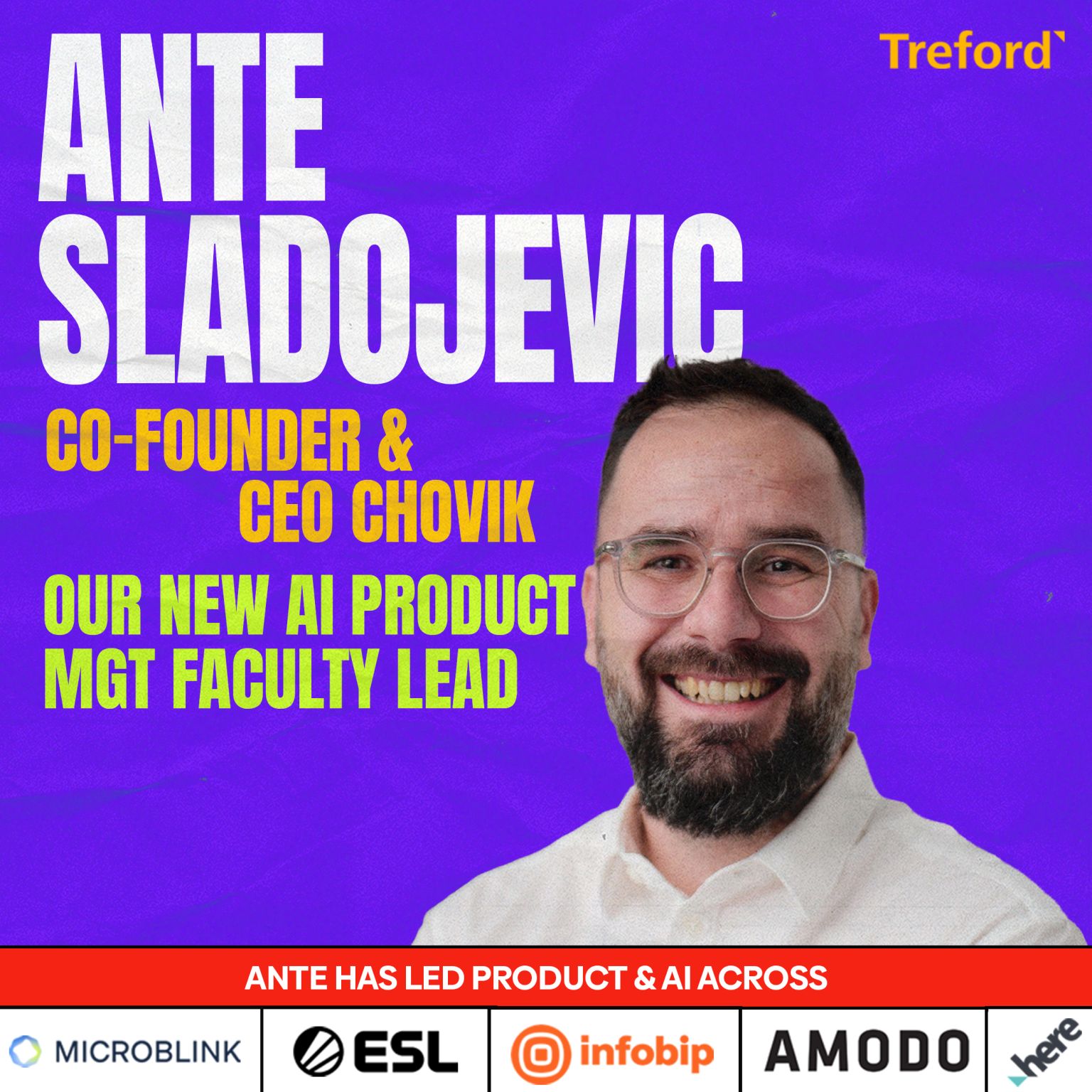
This one started when a mutual acquaintance connected me and Harry Enaholo a few months ago. He mentioned Treford was exploring an AI Product Management program and needed someone who could bring real-world experience into the classroom.
We got on a call. Then another one. And within a few days, the two of us were sketching out what eventually became the full 7-week journey.
What problems do PMs actually face when building AI products?
What skills does the market pretend to teach, but never really does?
How do you design a curriculum that reflects the real work — the uncertainty, the iteration, the collaboration, the mess?
These were the same questions I explored in AI Product Strategy — and they became the backbone of how we structured this program.
From that first meeting, we built the program from scratch: the strategy, the modules, the sequencing, the exercises, the assignments, the capstone format. We iterated constantly — adjusting content, refining the narrative, making sure everything flowed the way real AI product development flows.
Fast-forward to today: we are at the finish line.
✔ ️Seven weeks of live sessions are done.
✔ ️Two weeks of capstone work behind the teams.
✔ And last week participants presented their final products — full AI strategies, prototypes, UX flows, and roadmaps. This was the culmination of everything we built.
What this program is — and who it’s for
This isn’t a “certificate course.” It’s designed to create AI product managers — people who understand how to identify the right problems, how to evaluate data, how to work with DS/ML teams, how to manage uncertainty, and how to build products responsibly. Much of this echoes what I wrote in The AI Product Manager.
Participants came from Africa, Europe, and North America. They brought experience from fintech, marketplaces, health, education, logistics, and SaaS.
And every one of them wanted the same thing: to become fluent in building AI products.
Treford's vision is ambitious: build an ecosystem of AI-ready product talent across continents. And this cohort proved how real that ambition is.
Behind the scenes: What my role looked like
From that initial meeting with Harry through the final capstone round, I shaped the program end-to-end, defining and driving how it works from design to execution.
Over these seven weeks, my role included:
- Building and delivering program modules
- Designing the structure of assignments and reviewing them weekly
- Guiding participants as they shaped their product ideas
- Helping teams refine their data plans, system designs, and prototypes
- Preparing them for their final 20-minute presentations
- Giving continuous feedback that pushed ideas from “interesting” to “realistic and defensible”
“I rarely meet people who match my work ethic, but I won’t be exaggerating when I say Ante surpassed it. His passion, dedication, and holistic approach fundamentally shaped our AI Product Management program at Treford.”
Harry Enaholo, CEO and Cofounder at Treford
For the last few weeks, my inbox has been full of prototypes, models, UX mocks, strategy docs, and “Does this make sense?” questions. This was exactly what I wrote about in The ML Product Lifecycle (and how PMs should think at each stage): real learning happens when teams move from theory → data → modeling → UX → metrics → iteration.”
And the quality?
Honestly — impressive.
Some teams built competitors to major AI products in the market.
Others solved deeply operational problems with smart ML workflows.
A few came up with ideas I haven’t even seen companies attempt yet — and that’s the clearest signal that the program did what it was supposed to do.
Harry said something else that meant a lot to me, and reflects the spirit of this collaboration:
“Ante took this program to a whole new level with so much research and practical AI product experience from his decades of building, shipping, and managing products across Europe. We welcomed product managers from Africa, Europe, and North America — and we never had to worry about any part of the program because of Ante.”
What participants actually learned — and how it all came together
Across the weeks, we covered the full spectrum of AI product management. They practiced everything we’ve been discussing across my recent blogs:
- How AI and ML actually work — the parts PMs must understand
- How AI product lifecycles differ from traditional ones
- How to frame AI opportunities through strategy and metrics
- How to work with DS/ML teams and evaluate models
- How to design AI UX around trust, transparency, and uncertainty
- How to run AI experiments, interpret outputs, and refine systems (AI Evals)
- How to think about responsible AI and safety
- How to lead AI initiatives inside an organization
And on Saturday, it all came together.
Each team presented their end-to-end AI product:
- Problem definition
- Data readiness & constraints
- ML opportunity
- High-level model strategy
- UX and explainability
- Metrics for both product and model
- Roadmap
- Working prototype
Twenty minutes per team.
Real problems.
Real products.
Real learning.
Seeing their work — and the way they justified decisions, articulated trade-offs, and communicated uncertainty — was the best proof of how much they’ve grown in just a few weeks.
Special Thanks
A program like this doesn’t happen because of one person. It happens because of a community that brings the right expertise together.
To Harry Enaholo — for the vision, the trust, and for building something far bigger than a “course.” You’re building a market, a talent pipeline, and a global community.
To Majana Havranek — for transforming how participants think about AI UX, trust, and explainability.
To Omoniyi Omotoso — for demystifying prompt engineering, context management, and generative AI workflows.
To the Treford team — for flawless coordination, logistics, and support throughout all nine weeks.
And to the participants — thank you for the ambition, the effort, the late-night iterations, the prototypes, and the willingness to learn publicly and honestly.
This program exists because of you.
If your team wants to build AI products with confidence — let’s talk
At Chovik, I help product teams build AI products end-to-end — from strategy and feasibility to design, deployment, and iteration.
I also coach PMs individually and in teams so they can confidently operate in this new era of AI-driven product development.
If you want to level up your AI product skills — or bring this kind of training to your organization — reach out -> Contact.